Blog
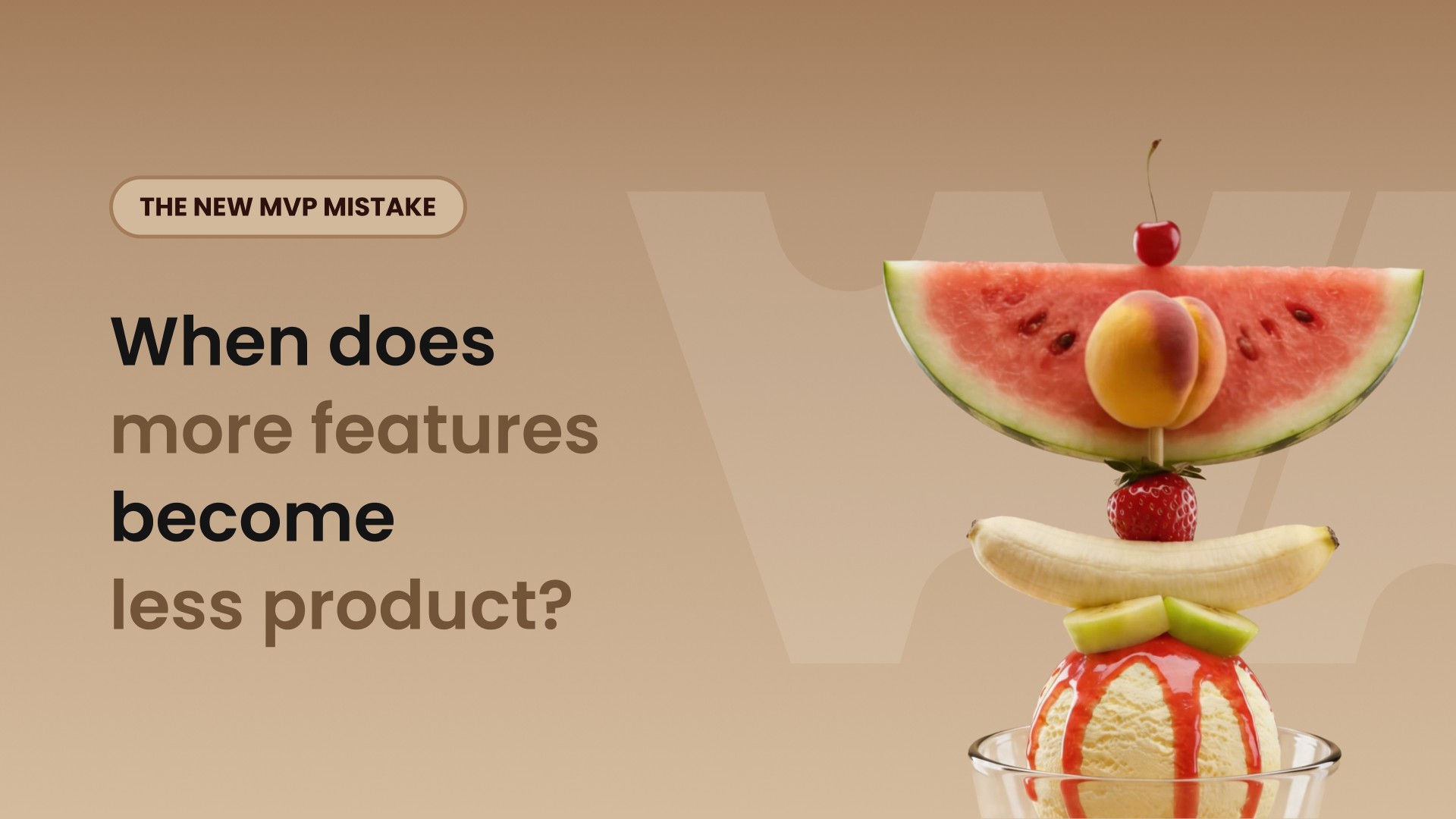
The New MVP Mistake: Shipping Too Much Because AI Made It Cheap
Alex Dimov
•
Apr 21, 2026, 3:00 PM
A few years ago, building an MVP was constrained by one thing: time.
You had limited engineering capacity. Every feature cost real effort. Every extra screen meant delays. So founders were forced to focus.
The question was simple:
What is the smallest thing we can build to learn something real?
Today, that constraint is weaker. AI tools can generate code, UI, APIs, even entire flows in hours. What used to take weeks now takes days. And that sounds like a win. But it created a new problem. Now founders ship too much.
Then vs Now: What Actually Changed
Before AI:
You cut features because you had no time
You shipped fast because speed was survival
You focused because you had no choice
Now:
You can build more than you need
You are tempted to include “just one more thing”
You delay launch because “it is almost ready”
The constraint moved from engineering capacity to decision discipline. And that is harder. Because saying “no” is no longer forced by reality. It is a choice.
Why “More Features” Feels Like Progress (But Isn’t)
AI makes it very easy to confuse output with progress.
You see:
More screens
More flows
More automation
More integrations
It looks like the product is becoming “complete”. But your users do not care about completeness.
They care about:
Does this solve my problem?
Can I trust it?
Is it easy to use?
Adding more features too early usually creates:
A blurry value proposition
If your MVP does 5 things, users do not understand what it is for. If it does 1 thing well, they get it instantly.
Slower feedback cycles
More features = more things to test.
You no longer know what caused success or failure. Was it the onboarding? The AI feature? The pricing? The UX?
You lose clarity.
Hidden complexity
AI-generated code still needs:
QA
edge case handling
performance tuning
monitoring
More features = more surface area for things to break.
Fake confidence
This is the most dangerous one. You feel like you have built something “serious”. But you still have zero proof that users want it.
The Real Shift: MVP Is No Longer About Speed Alone
Before, speed was the main constraint.
Now, focus is the main constraint.
AI did not remove the need for an MVP. It made the MVP easier to mess up.
Because now the question is not:
“What can we build in time?”
It is:
“What should we NOT build, even if we can?”
A Better Way to Think About MVP in 2026
A strong MVP today is not:
❌ the fastest to build
❌ the most feature-rich
❌ the most “AI-powered”
It is:
✅ The fastest way to validate one core assumption.
That is it. Everything else is noise.
A Simple 6-Week MVP Plan
Here is a practical structure we use with founders. It keeps AI as a tool, not a distraction.
Week 1: Define the ONE problem
👉 Who is the user?
👉 What exact problem are they facing?
👉 When does it happen?
Force clarity.
If you cannot explain the problem in 2–3 sentences, you are not ready to build.
Week 2: Define the ONE outcome
👉 What does success look like for the user?
👉 What changes after they use your product?
Example:
❌ Not: “Generate AI insights”
✅ Better: “Help sales teams prepare for calls in under 5 minutes”
Week 3: Design the simplest path
Map the shortest journey:
Input → Processing → Output
Remove everything that is not essential. This is where most teams fail today.
They add:
📊 dashboards
⚙️ settings
➡️ extra flows
🧑💻 edge features
You do not need them yet.
Week 4: Build only the core flow
Use AI tools aggressively here. Speed matters again. But only for:
the main user action
the main output
Ignore everything else. No “nice to have”.
Week 5: Test with real users
Not friends. Not your team. Real users.
Watch them:
➡️ where they get confused
➡️ where they hesitate
➡️ what they ignore
This is where most insights come from.
Week 6: Decide, do not expand
This is critical.
Do NOT add features immediately.
Instead, decide:
👉 Is the problem real?
👉 Do users care?
👉 Would they pay or come back?
Only then:
double down
pivot
or stop
Where AI Actually Helps in This Process
AI is incredibly useful. But in specific places:
✅ speeding up development (Week 4)
✅ generating variations for testing
✅ helping with internal tools
✅ automating repetitive parts
Where it does NOT help:
❌ deciding what to build
❌ understanding users
❌ defining value
Those are still human problems.
The Real Risk for Founders Right Now
It is not that you will build too slow. It is that you will build too much before learning anything.
And that wastes:
⌛ time
💸 budget
🏃🏻♂️➡️ momentum
In a more subtle way.
Final Thought
AI removed a lot of friction from building. But it did not remove the need for product thinking. In fact, it made it more important.
Because now:
The teams that win are not the ones who build the most.
They are the ones who build the right thing first.
If you are planning an MVP and want a second opinion before you overbuild it, that is exactly where we can help.
A quick conversation can save you weeks of building the wrong thing.