Blog
The biggest obstacles are also the biggest opportunities
Alex Dimov
•
Mar 10, 2026, 12:00 AM
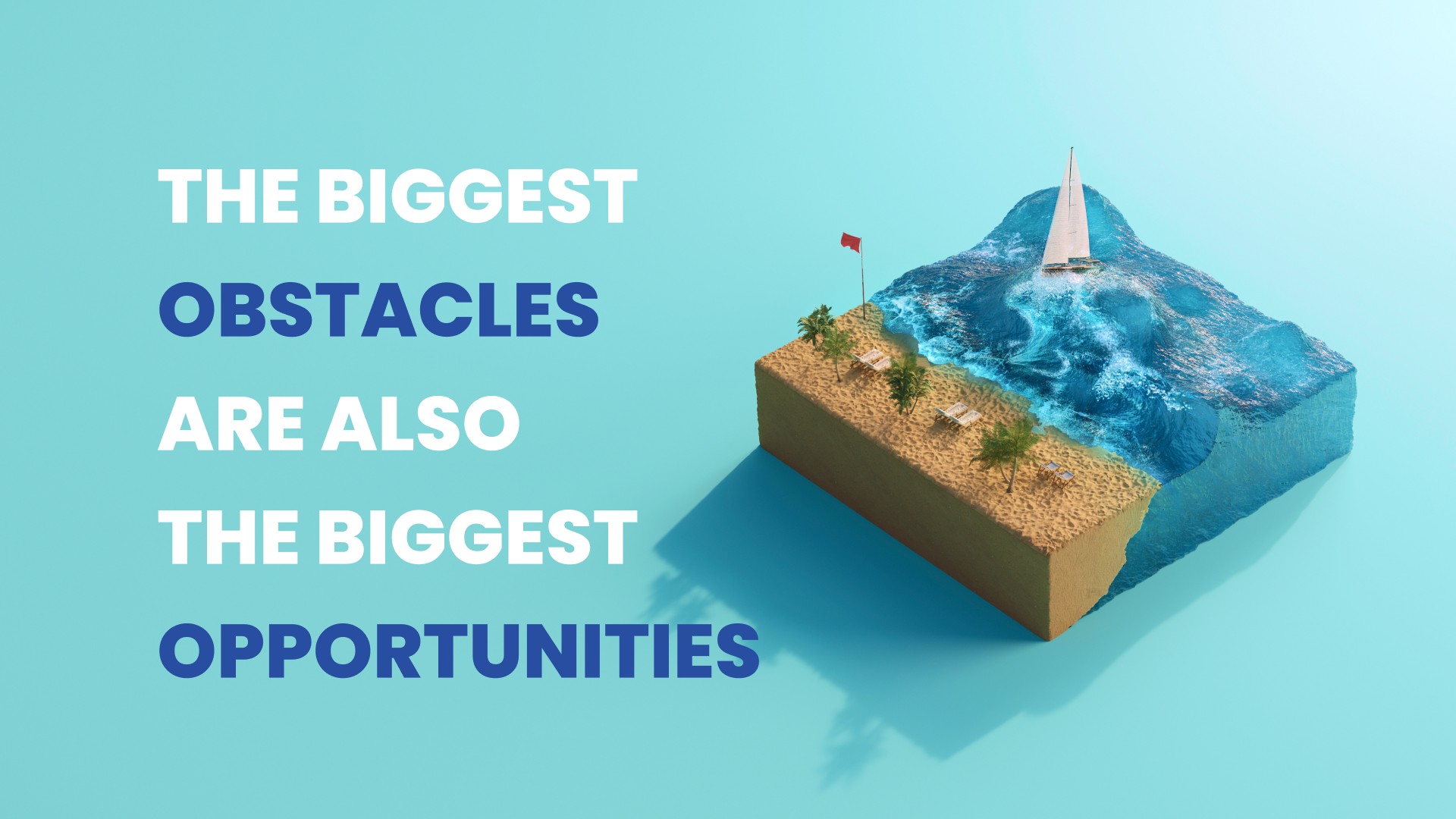
Every founder says they want growth but very few are excited about the obstacles that come with it.
Yet, in business, the biggest breakthroughs usually hide behind the biggest problems. There is an old anecdote I love:
For centuries, people saw the ocean as a limit.
It separated lands. It was dangerous. Unpredictable. A barrier.
Then someone looked at the same ocean and thought:
What if this is not a wall, but a road?
They built a boat. And suddenly, what looked like a border became access to trade, new markets, new knowledge, new wealth.
The ocean did not change.
The mindset did. That pattern repeats in every serious company story.
A real example: Netflix
In the early 2000s, Netflix had a big problem - they were mailing DVDs. It worked but broadband internet was getting faster, piracy was rising, physical media was declining. For many companies, that would have been a threat. For Netflix, it was the moment to reinvent itself. Instead of protecting the DVD business, they invested heavily in streaming. Then they went further and started producing original content.
The obstacle was clear:
Internet would kill DVD rentals.
Content licensing was expensive.
Big studios had more power.
The opportunity they saw:
Streaming removes distribution friction.
Data allows better content decisions.
Owning content gives long-term leverage.
Today, Netflix is not a DVD company. It is a global streaming and content powerhouse. They did not avoid the wave. They surfed it.
Why this is even more valid in business today
The pace of change is much faster now.
Markets shift quickly.
Customer expectations rise constantly.
New tools appear every month.
For startup founders and product owners, obstacles show up in many forms:
Low user retention
High acquisition costs
Slow development cycles
Strong competition
Legacy systems that block innovation
Most teams react defensively:
Cut features
Freeze hiring
Blame the market
Protect what exists
But the better question is: If this problem exists, what opportunity is hidden inside it?
Examples:
Low retention
Instead of adding more features, you might discover your core value is unclear. Fixing that can lead to a stronger, simpler product.
High acquisition costs
Maybe your positioning is wrong. Refining it could open a niche market with less competition and higher margins.
Slow development
This might force you to rethink architecture, simplify your roadmap, or move to a better tech stack. Long term, this makes you faster than competitors.
In product development, constraints often create clarity.
Clarity ➡️ creates focus.
Focus ➡️ creates advantage.
How AI is disrupting this dynamic
AI is amplifying both the obstacles and the opportunities.
On one side:
💢 AI lowers the barrier to entry.
💢 New competitors can build MVPs faster.
💢 Features that used to be complex are now commodities.
That is scary.
On the other side:
✨ AI enables automation of internal processes.
✨ AI enhances product capabilities.
✨ AI unlocks data insights that were previously unreachable.
✖️ The obstacle: Your competitive moat might disappear faster.
❇️ The opportunity: You can build smarter products with smaller teams.
For example:
✔️ Customer support can be partially automated.
✔️ Internal analytics can be enhanced with AI-driven insights.
✔️ MVP validation can be faster with AI-assisted prototyping.
The companies that win will not be the ones that complain about AI. They will be the ones that redesign their product and operations around it.
Just like the ocean. 🌊
The real shift: from reactive to strategic
The difference between struggling companies and growing ones is not the absence of problems. It is their interpretation of them.
Reactive mindset:
❌ This is a threat.
❌ This is unfair.
❌ This is too risky.
Strategic mindset:
✅ Why is this happening?
✅ What structural change does this signal?
✅ How can we benefit if this trend continues?
Most founders say they want innovation. But innovation is uncomfortable. It usually starts with friction. Sometimes what feels like a crisis is just the market telling you to evolve.
A short guide to seeing problems as opportunities
Changing mindset is not motivational talk. It is a practical skill.
Here is a simple framework you can use.
Separate facts from emotion
Write down the problem in neutral terms.
✖️ Instead of: "Our churn is terrible and we are failing."
✔️ Write: "Monthly churn increased from 4 percent to 7 percent in 3 months."
Clarity reduces fear.
Ask: What does this make possible?
Every constraint creates a new direction.
If funding is limited: ➡️ You are forced to prioritize only high-impact features.
If customers complain about complexity: ➡️ You can simplify and differentiate on usability.
If development is slow: ➡️ You can invest in better architecture or a stronger product process.
Zoom out
Is this problem local, or part of a larger shift?
For example:
If customers demand AI features, it is not just a feature request. It may signal a market-wide expectation change.
Zooming out helps you see the “ocean” instead of just the wave.
Run small experiments
Opportunities do not need to be fully proven before action.
Test:
A new pricing model
A simplified onboarding flow
An AI-powered feature prototype
A new niche positioning
Small experiments reduce risk while exploring upside.
Surround yourself with builders
Mindset is contagious.
If your team only talks about risks, you will see walls everywhere.
If your team is trained to ask: "How could we use this to our advantage?"
You start seeing boats instead of barriers.
This is not easy. But it is trainable.
Final thought
🌊 The ocean is still dangerous.
📊 Markets are still competitive.
❓ Technology is still unpredictable.
🏅But history shows something consistent: The people who build boats win.
Obstacles are rarely pleasant. Sometimes they are messy and stressful. But inside them is usually a shift that others are afraid to embrace.
The question is simple: Are you looking at a wall, or at a road?
In 2026 and beyond, with AI reshaping entire industries, this question matters even more. Your biggest obstacle today might be your biggest leverage tomorrow.
If you are building a digital product and facing a technical or strategic bottleneck, maybe that is not just a problem. Maybe it is the moment to rethink your architecture, your positioning, or your product strategy.
And that is where real growth begins.