Blog
Is the SaaS-pocalypse Here?
Alex Dimov
•
Feb 25, 2026, 12:00 AM

Or Are We Just Entering the Most Interesting Era of Software Yet?
Recently, we have started to see software stocks wobble. Investors are asking harder questions. Growth multiples are not what they used to be.
At the same time, AI agents are getting smarter every single week.
So the obvious question appears:
Is this the SaaS-pocalypse?
Short answer: not exactly.
Long answer: something big is changing. And if you are building SaaS, you need to understand what that change really means.
Let’s unpack it calmly. No dramatic background music required.
The Real Shift: Value Is Being Compressed
For the last 15 years, SaaS followed a relatively predictable formula:
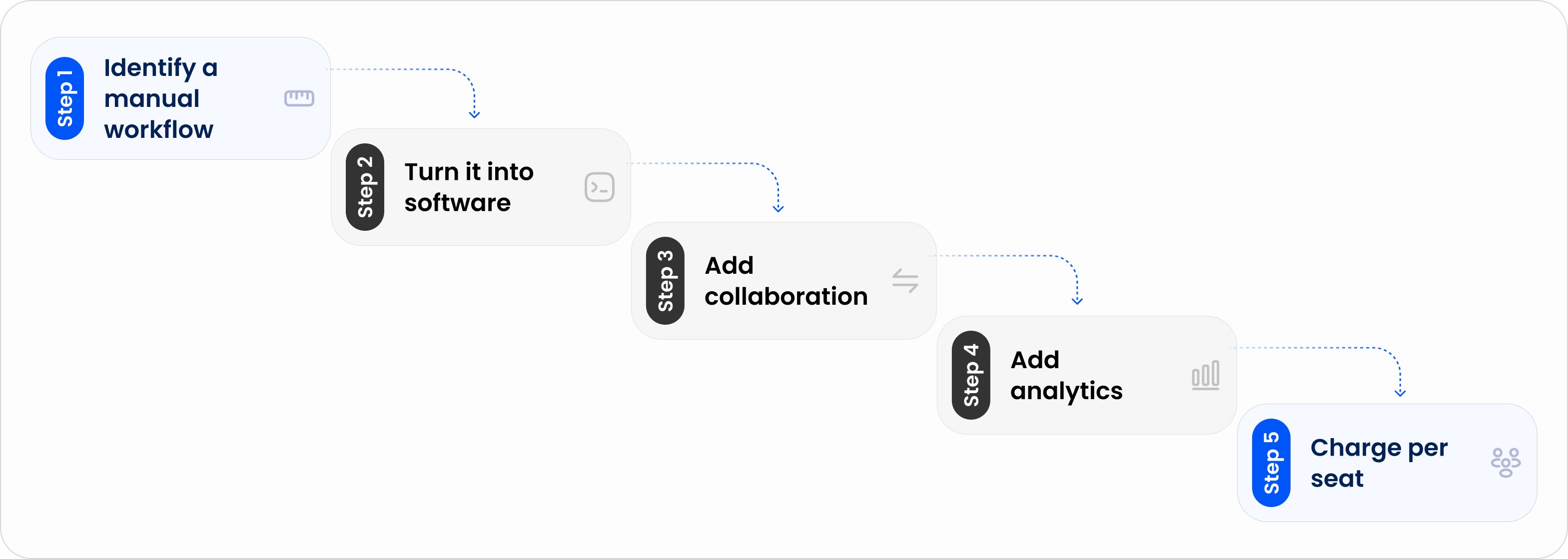
Identify a manual workflow
Turn it into software
Add collaboration
Add analytics
Charge per seat
That playbook worked. Extremely well.
But AI is compressing value in a way we have not seen before.
Features that once required:
➡️ Months of engineering
➡️ A dedicated data team
➡️ Custom rule engines
➡️ Endless dashboard building
…can now be generated, automated, or replaced by AI in minutes.
That changes the economics and if your product is:
A wrapper around publicly accessible data
A task tracker without automation
A thin UI layer over someone else’s API
A workflow that can be replaced by a well-written prompt
… you are exposed.
Not because you built something bad. But because the barrier to replicating it just dropped dramatically.
The End of “Feature Moats”
There was a time when shipping a feature first was a moat.
Now? Features are increasingly commodities.
AI can:
📝 Draft reports
🗂️ Classify documents
📋 Extract insights
📑 Generate dashboards
✉️ Write emails
📃 Analyze contracts
📓 Summarize meetings
🖥️ Produce code
And it does not care how many engineers you have.
The old advantage was: “We built it before others.”
The new advantage is: “We integrated it deeper into the workflow than anyone else.”
That is a very different game.
But Here Is the Good News (And It Is Real)
This shift does not kill SaaS.
It kills lazy SaaS. And that is healthy. Small teams now have an unfair advantage.
You can:
✅ Design AI into your product from day one
✅ Build workflows assuming intelligence is embedded
✅ Rethink pricing around outcomes, not seats
✅ Move weekly, not quarterly
✅ Go deep into a vertical and dominate it
Large incumbents are constrained by their:
❌ Legacy codebases
❌ Enterprise contracts
❌ Slow decision cycles
❌ Political layers
❌ Revenue to protect
You have none of that. You have speed. And in an AI-native world, speed compounds.
From Software as a Tool to Software as an Operator
Traditional SaaS was a tool.
You logged in.
You clicked.
You updated fields.
You exported reports.
You did the work.
AI-native SaaS starts to behave differently:
Suggests actions
Executes tasks
Automates follow-ups
Detects anomalies
Writes summaries
Drafts decisions
It becomes less of a dashboard and more of an operator.
Users will increasingly expect this. No one wakes up excited to “manage tasks.” They want outcomes. And AI allows software to move closer to outcomes.
The Pricing Earthquake
Seat-based pricing made sense when value scaled with the number of humans using the tool.
But what happens when:
One AI agent replaces three seats?
Automation reduces manual input?
A team of five produces the output of twenty?
We will see more:
Usage-based pricing
Outcome-based pricing
Hybrid models
Performance-driven pricing
If your revenue depends purely on adding more seats, you might feel pressure. If your revenue depends on delivering measurable value, you have leverage. This is an opportunity to rethink monetization early.
Vertical Depth Wins
Generic horizontal tools will struggle.
Why?
Because AI models are generalists.
If you are building something generic, you are competing directly with general intelligence. And that is a tough fight. But if you go deep into a vertical:
Healthcare compliance
Maritime logistics
Specialty insurance underwriting
Coffee supply chain risk analysis
Now you are layering:
✔️ Domain expertise
✔️ Structured data
✔️ Workflow specificity
✔️ Industry nuance
AI becomes your engine, not your competitor. Vertical SaaS combined with AI is extremely powerful. It creates defensibility through context.
What Makes a SaaS Startup Resilient in 2026?
Here is what we are seeing:
Native AI Thinking
Do not bolt AI on as a feature. Design around it.
Ask:
What would this workflow look like if intelligence was embedded from day one?
What disappears?
What becomes autonomous?
Real Data Loops
Your moat is not the interface. It is the data loop.
If your product:
Learns from usage
Improves predictions
Adapts recommendations
Refines automation
You are compounding value.
If it does not learn, it stagnates.
Deep Workflow Integration
Surface-level features are fragile. Workflow-level integration is sticky.
When your software:
➖ Connects to core systems
➖ Becomes embedded in daily operations
➖ Handles critical decisions
It becomes difficult to replace.
Even if someone can replicate your feature list.
Speed of Iteration
In the AI era, product cycles compress.
The winning teams:
✅ Ship fast
✅ Test aggressively
✅ Kill features quickly
✅ Iterate weekly
Not quarterly roadmaps carved in stone.
The advantage is not perfection. It is adaptation.
So Is This the SaaS-pocalypse?
No.
It is the end of comfortable SaaS.
It is the end of:
Selling dashboards as innovation
Raising money on feature checklists
Assuming incumbents will stay slow
It is the beginning of something more interesting.
Software that:
🧠 Thinks
💪 Acts
📖 Learns
📈 Improves
And startups that are:
Lean
Opinionated
Vertical
AI-native
Will thrive.
A Final Thought
Every technological shift feels like a threat when you look at it from the old model. It feels like leverage when you design for the new one. The companies that win in this cycle will be the ones that quietly rebuild their entire product around the assumption that intelligence is now cheap and abundant.
If you are building SaaS right now, this is not the time to panic. It is the time to rethink. And that is a far more exciting place to be.